
 (1)20251001101822.jpg)
Lot n° 166
Estimation :
300 - 400
EUR
Jean-Baptiste PERRONNEAU - Lot 166
Jean-Baptiste PERRONNEAU
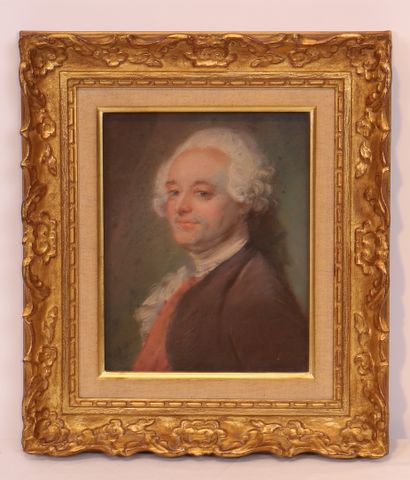
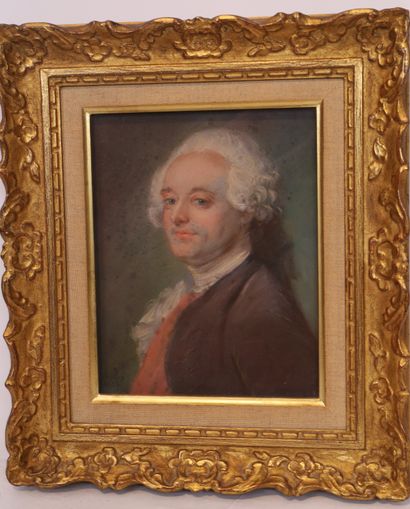
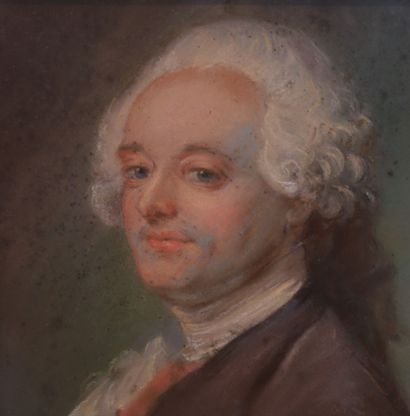
Very nice painting "PORTRAIT OF A QUALITY MAN" IN THE GOUT OF Jean-Baptiste PERRONNEAU (1715-1783)
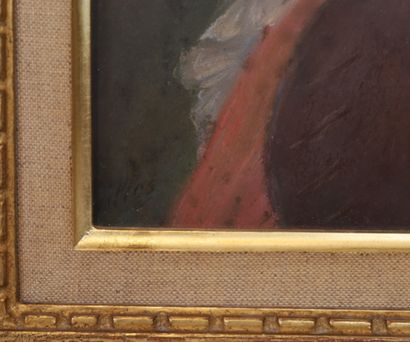
Pastel signed Gilles in the lower left corner
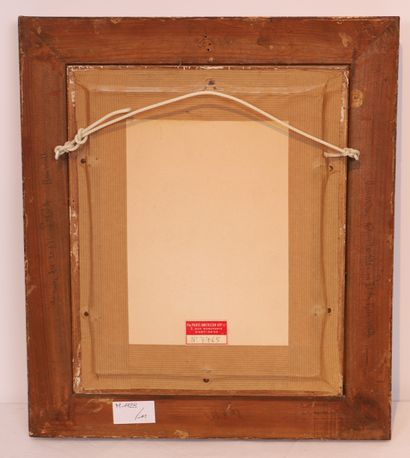
Gilded wood frame
19th century
Sight : 23,5 x 18 cm
Jean-Baptiste Perronneau is the son of Henri Perronneau ("bourgeois de Paris", according to the artist's marriage contract) and Marie-Geneviève Frémont. He was born in Paris in 1715 on a date that is not known. Still very young, he was apprenticed as an engraver to Jean-François Cars (1661-1738), an engraver from Lyon whose son Laurent (1699-1771) became one of the most famous engravers of the century. He owes his first training as a painter to Charles-Joseph Natoire (1700-1777), First Grand Prix de Rome in 1725 and director of the French Academy in Rome in 1751.
After his training, Perronneau began to work as an engraver, in particular for Gabriel Huquier (1695-1772), established in rue Saint-Jacques. We have prints signed "j. b. Perronneau" from 1738. In the 1740s, he began his career as a portraitist with oils or pastels, the fashion for which had been launched at the beginning of the century by the Venetian Rosalba Carriera.
In 1746, Perronneau entered the Royal Academy as an approved artist on presentation of several pastel portraits. The title of agrégé, awarded on presentation of "pieces d'agrément", preceded by several years the eventual admission as a member of the Academy on presentation of a "piece de réception" which had to be a work of high quality. The simple approval allowed the artist to exhibit at the official Salon, which Perronneau did from 1746. He continued to exhibit at the Salon in subsequent years, but without being noticed.
Diderot relates that at the 1750 Salon, two portraits of the great pastelist Maurice Quentin de la Tour were exhibited: a portrait by Perronneau and a self-portrait by Quentin de la Tour. Art lovers of the time praised the one by Quentin de la Tour and despised the other. According to Diderot, it was Quentin de la Tour who had proposed to Perronneau to paint his portrait in order to humiliate him publicly. The malignity of Quentin de la Tour is not proven but he was the portraitist of the court while Perronneau became the portraitist of the bourgeoisie.
In 1753, Perronneau presented his two reception pieces imposed by the Academy: the portrait of the painter Jean-Baptiste Oudry (1686-1755) and that of the sculptor Adam l'Aîné (1700-1759). He was admitted to the Royal Academy of Painting and Sculpture. These portraits are finally praised by connoisseurs. The abbot Le Blanc writes:
"The various portraits of M. Perronneau are so many proofs of the progress he makes daily in his art. We can see that he seeks out nature as a man who knows its full value. The example of several painters proves that the eyes of the body are not enough to perceive it; it can only be grasped with the eyes of the mind. It cannot escape someone who has all that makes the merit of the artist's touch.
From then on, commissions were pouring in and the artist was thinking of establishing himself. On November 9, 1754, he married Louise-Charlotte Aubert, daughter of the miniaturist François Aubert, in the church of Saint-Barthélemy in Paris. In 1755, he sent eighteen portraits to the salon. But, in 1756, for an unknown reason, he starts to travel while actively pursuing his activity as a painter. In 1756, he was in Bordeaux, then returned to Paris in 1757 and exhibited several portraits at the Salon. His travels continued thereafter without any details being known: he was in Lyon in 1759 to paint portraits and visited northern Italy on this occasion, then returned to Paris to face up to difficulties with his property.
At the beginning of the 1760s, Perronneau spent two to three years in Holland and did not exhibit again at the Salon until 1763. A certain lull appeared during the following years, the painter even acquiring for 16 000 livres a house at the barrier of Montreuil, to be used as a summer residence (the salary of a day labourer is a little more than one livre per day). His wife gave birth to a son in 1766 and a second in 1773.
Then Perronneau resumed his peregrinations in France (Bordeaux, Lyon) and abroad (Netherlands). It was during a stay in Holland that he died in Amsterdam on November 19, 1783. He is buried in this city in the Leiden cemetery.
My orders
Sale information
Sales conditions
Return to catalogue